

Why International Schools Design for Mimicry (And How Transformative Leaders Fix It)
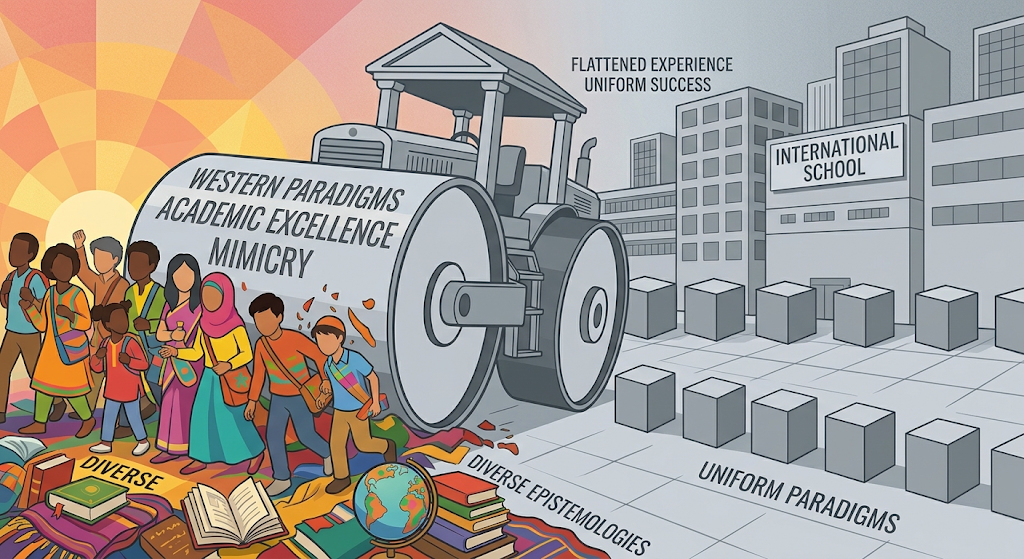
If you’ve worked in an international school environment long enough, you begin to notice the flattening. The flattening is a phenomenon at odds with the perceived benefits of international schools such as the intercultural collaboration and experiences, high quality education, and a globalist view of equity and justice. The classic image of a Third Culture Kid (TCK) is that of the effortlessly adaptable, mobile, and multilingual citizen of the world. However, what’s happening in practice is a flattening of the core experiences these TCKs go through.
In an effort to ensure smooth transitions for students and their families and as a result of their history, international schools rely strictly on Western paradigms of success and value Western systems and structures over any Indigenous or local epistemologies, systems, and structures. When schools rely solely on Western epistemologies, they push their prime demographic, TCKs, into a state of post-colonial mimicry that is a rejection of the ideals of an international school.
Mimicry and Hybridity
Homi Bhabha first coined the terms mimicry and hybridity in his post-colonial treatise titled The Location of Culture. He defined mimicry as the colonized individual taking the most desirable parts of the colonizer (e.g., dress, beliefs, ethics) as a core part of themselves, thereby becoming a member of that community though they will never be seen as a true member. This reminds me of the civilizing views of Canadian settlers toward the Indigenous Peoples of Canada, which resulted in a genocide. This colonial mindset is alive and well in globe-spanning oragnizations to this day, still framed through progress and economic benefit.
Bhabha is discussing the immigrant experience more than he is discussing the unique upbringing of TCKs, but the parallels with the modern international school are certainly relevant. Mimicry is a pervasive colonial attitude or mindset that, I think, still exists today with how a dominant culture views the immigrant as well as how the immigrant views the dominant culture and tries to embed themselves in it.
For Bhabha, hybridity is a state of living in the Third Space, which directly aligns linguistically and philosophically with van Reken et al.’s definition of the Third Culture Kid. Bhabha sees hybridity as a national or individual mixture of identities, similar to mimicry, but it comes from a place of resistance to the hegemony of Western identities and beliefs. Individuals have to live in and oscillate between multiple spaces such as their cultural background and the cultural “foreground” of the new country and culture. Bhabha uses a staircase metaphor from Renee Green to demonstrate a hybrid individuals Third Space negotiation (Figure 1).
Figure 1
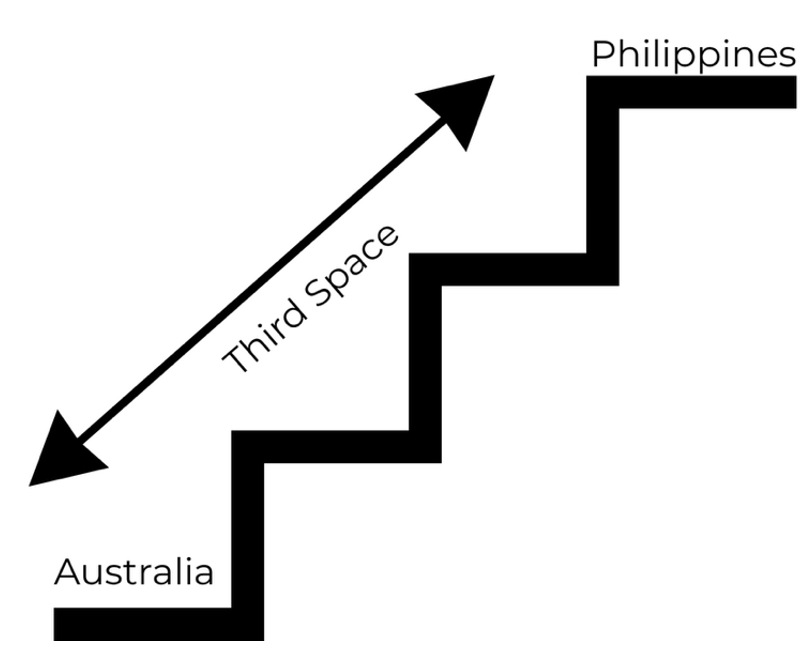
Visual Metaphor for the Third Space of Cultural Identity
The illustrative example shows the third space that Third Culture Kids live in, a state of hybridity, as they navigate the complex cultural identity formation.In practice, both mimicry and hybridity are lenses to view the different experiences of transnationals around the world. For international schools around the world, they are helpful lenses to audit how we plan for the learning of our TCKs, the profiles of graduates we hold, and our fundamental and necessary work toward global equity and social justice.
Transformative Leadership
I see the work of international schools to be fully entrenched in the work of equity and social justice. International schools are places of privilege, often with colonial undertones, where learners have opportunities to achieve great things due to the highly qualified teachers, the support programs in place, and the enrichment opportunities that happen during and after school days. However, so many international schools exist as bubbles outside of the community within which they reside and more so within the larger global community.
This is where I see Transformative Leadership coming to the table. For educational leaders, a transformative approach is one that seeks out systemic change, the deconstruction and reconstruction of knowledge delivered through a shared vision and moral purpose. Transformative Leadership, according to Carolyn Shields, is rooted in justice, trust, and the public good. Leaders have an obligation to ensure the students that attend their school receive the highest quality education possible, and they would be remiss to think they do so if they are not effectively working to ensure that hybridity is the goal versus mimicry for their non-Western TCK students.
International schools offer the promise of hybridity but often design for mimicry, and it is sold as in the best interest of the school and the student because of the domineering pedestal that Western epistemologies hold over the international school spaces around the world. For change to happen, and to deconstruct these global power dynamics while addressed the public good, international school leaders need to move beyond the common approaches to leadership and toward one rooted in transformative change. The ultimate goal of international education isn’t to polish non-Western students until they seamlessly mimic those from the West; it is to cultivate a vibrant Third Space where their hybrid identities can flourish.
References
Azzi, I. (2018). Reading the “international” through postcolonial theory: A case study of the adoption of the International Baccalaureate at a school in Lebanon. The International Education Journal: Comparative Perspectics, 17(1), 51–65.
Bhabha, H. K. (2004). The location of culture. Psychology Press.
Gardner-McTaggart, A. C. (2020). Washing the world in whiteness; international schools’ policy. Journal of Educational Administration and History, 53(1), 1–20. https://doi.org/10.1080/00220620.2020.1844162
Hughes, C. (2009). International education and the International Baccalaureate Diploma Programme. Journal of Research in International Education, 8(2), 123–141. https://doi.org/10.1177/1475240909105201
Machin, D. (2019). The organisational evolution of contemporary international schools. Journal of Research in International Education, 18(2), 109–124. https://doi.org/10.1177/1475240919865033
Shields, C. M. (2024). Transformative leadership in education: Equitable, inclusive, and quality education in an uncertain and complex world. Taylor & Francis.
Shields, C. M., & Hesbol, K. A. (2019). Transformative leadership approaches to inclusion, equity, and social justice. Journal of School Leadership, 30(1), 3–22. https://doi.org/10.1177/1052684619873343
Sinclair, M. (2024). Who we are: Four questions for a life and a nation. McClelland & Stewart.
Useem, J., Useem, R., & Donoghue, J. (1963). Men in the middle of the third culture: The roles of american and non-western people in cross-cultural administration. Human Organization, 22(3), 169–179. https://doi.org/10.17730/humo.22.3.5470n44338kk6733
van Reken, R. E., Pollock, D. C., & Pollock, M. V. (2017). Third culture kids 3rd edition: The experience of growing up among worlds. Nicholas Brealey.
