

Most strategy lists tell you what to do. They don’t tell you who gets left out. Our middle school had a list like that. Then we started asking a harder question.
Over time, that question evolved into a comprehensive tool in the form of a slideshow that had many different strategies. Each slide contained a definition of the strategy, its use case, and images or a video that showed the strategy in action. We were able to collate some evidence of the strategies in action from classrooms and use those images in the slideshow. This was a great move as it allowed teachers to see the strategy in action, know who to talk to about implementing it, and provide evidence of our collective efficacy as a division.
The use of the slideshow was hit or miss at first, however, repeated exposure to it through faculty meetings, department meetings, and faculty growth meetings meant that it gained traction over time. In our school’s work on intercultural competency and social-emotional learning, we began with some big picture learning but eventually the work shifted to the classroom level. That shift prompted some questions on how to reframe our strategies in terms of their inclusivity and to consider who may be in the learning box and who may be left out. This inclusive design thinking resulted in the framework I share below. We utilized the framework to design a variety of “moves” that were applied to various common pedagogical strategies (e.g., see-think-wonder or vertical whiteboard learning). Suddenly, we had a toolkit of familiar strategies that could be easily adapted to be more inclusive given a particular learning experience. We sought feedback from various stakeholders and we trialed it with our Professional Learning Community. Here is an example of an annotated slide:
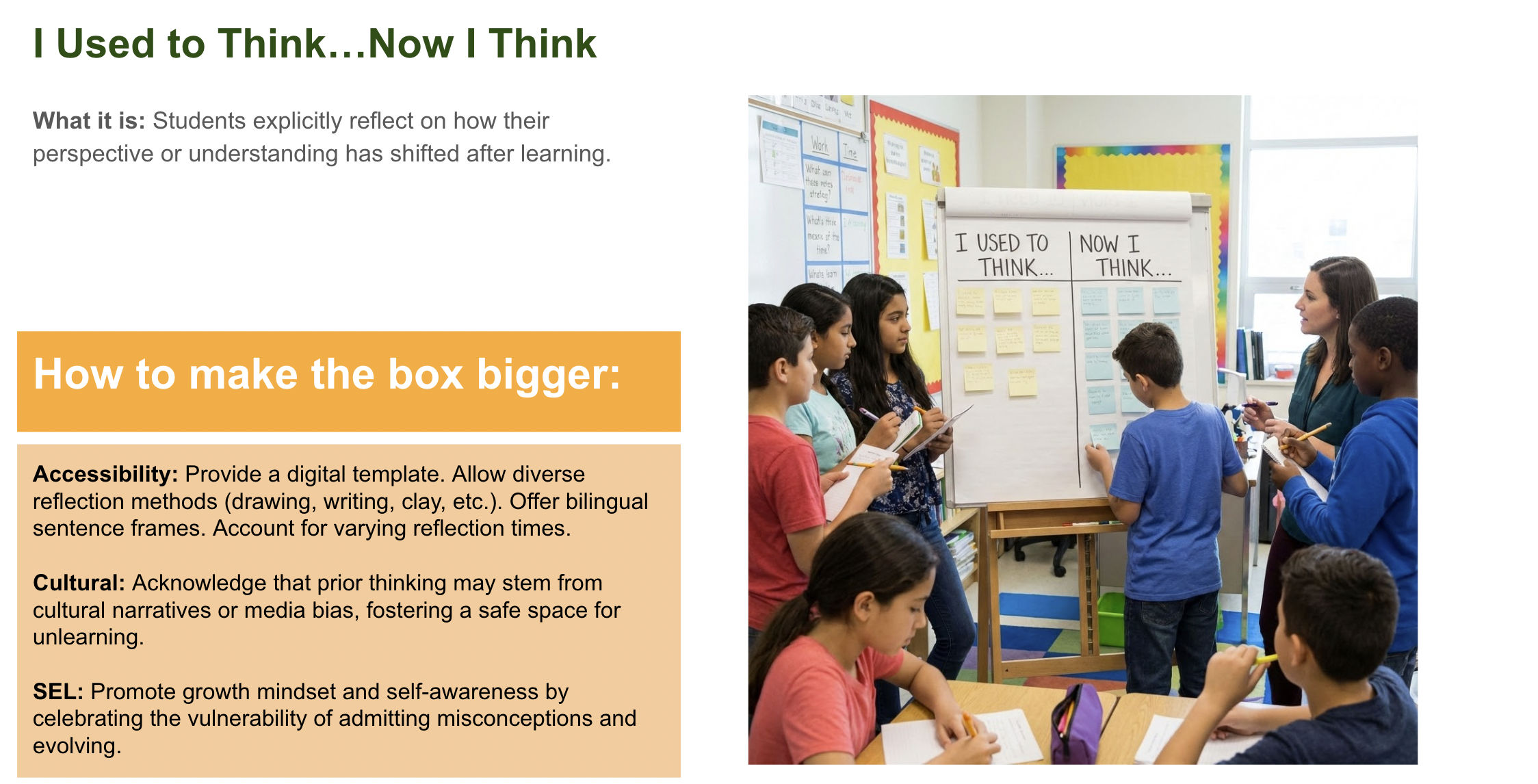
I Used to Think…Now I Think strategy annotated with accessibility, cultural, and social-emotional learning moves to make the strategy more inclusive.
The three moves are fairly simple, but they make the learning experiences of students more inclusive and help teachers to be more reflective as they plan for learning. The primary goal for the accessibility move was to ensure we limited any barriers to entry for our students. This is often seen in multi-modal practices and the provision of support for diverse learner needs. The cultural move’s goal was to honor the diverse experiences, perspectives, and backgrounds of the learners in the classroom. These were designed with an international school classroom in mind, but they could easily work in a public school anywhere around the world. The cultural move focused on the voice of the student (and the ancestral voice they carry) along with the communal knowledge-building we want to see in a classroom. Finally, the SEL move was focused on supporting the whole child outside of the other two moves. This move was focused primarily on mindsets of the teachers and the students as well as helping students to better develop their social and emotional toolkit.
To help teachers annotate or adapt other strategies not represented in our original toolkit, using Gemini I created two different infographics with related questions and additional information about the moves. Check them out and let me know what you think!
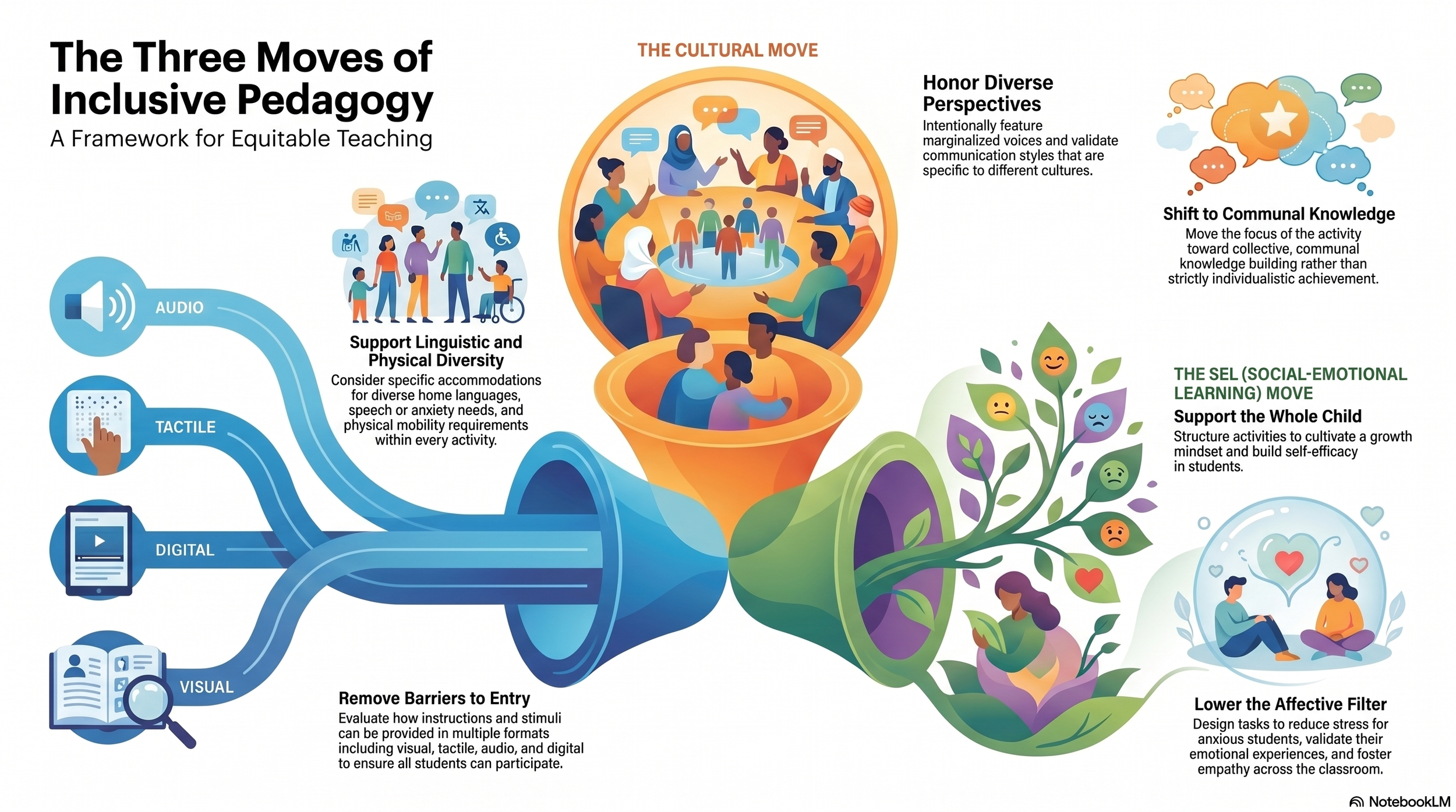
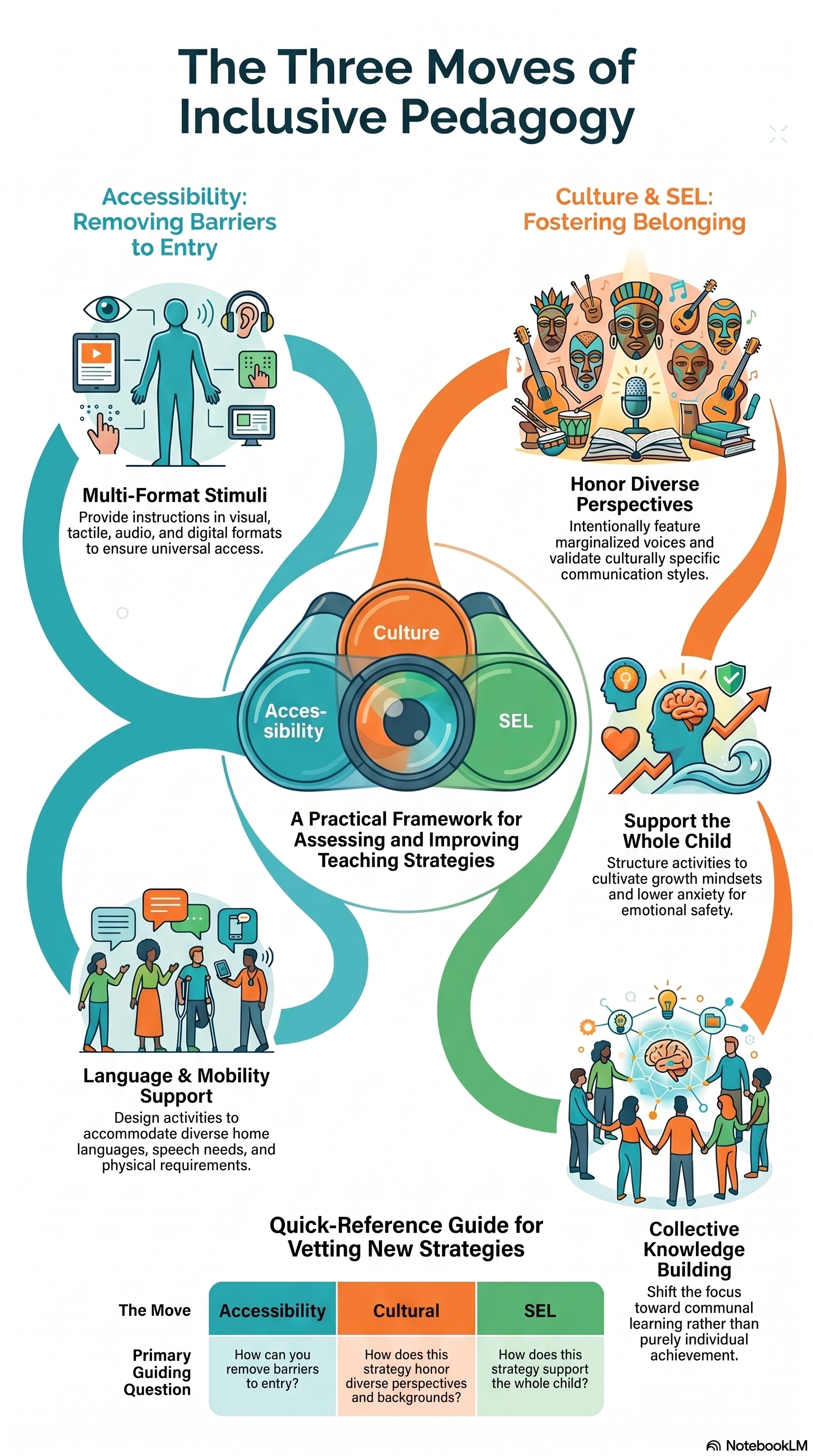
The Framework: Apply the "Three Moves"
When you want to use a strategy not found in this document use the following lenses and questions to guide your assessment of the tool or strategy.
Accessibility Move:
How can you remove barriers to entry?
Consider how you can provide stimuli or instructions in multiple formats (visual, tactile, audio, digital).
How can you support diverse home languages, speech/anxiety needs, or physical mobility requirements within this activity?
Cultural Move:
How does this strategy honor diverse perspectives and backgrounds?
Consider how you can intentionally feature marginalized voices, validate culturally specific communication styles, or shift the focus to collective, communal knowledge building.
SEL (Social-Emotional Learning) Move:
How does this strategy support the whole child?
Ask yourself how the activity can be structured to cultivate a growth mindset, build self-efficacy, or lower the affective filter for anxious students.
How can it be used to foster empathy and validate students' emotional experiences?
