

I recently attended the EARCOS Leadership Conference and the pre-conference session on MTSS with Dr. Lee Ann Jung. It was a great learning opportunity, and something she said really stuck out to me, especially as I think about the Relational Learning Design (RLD) framework. A question was asked about the challenging role of teaching/education assistants and the support they provide for specific students. Dr. Jung said that ”it’s pretty clear when we include kids they might not need someone right there.”
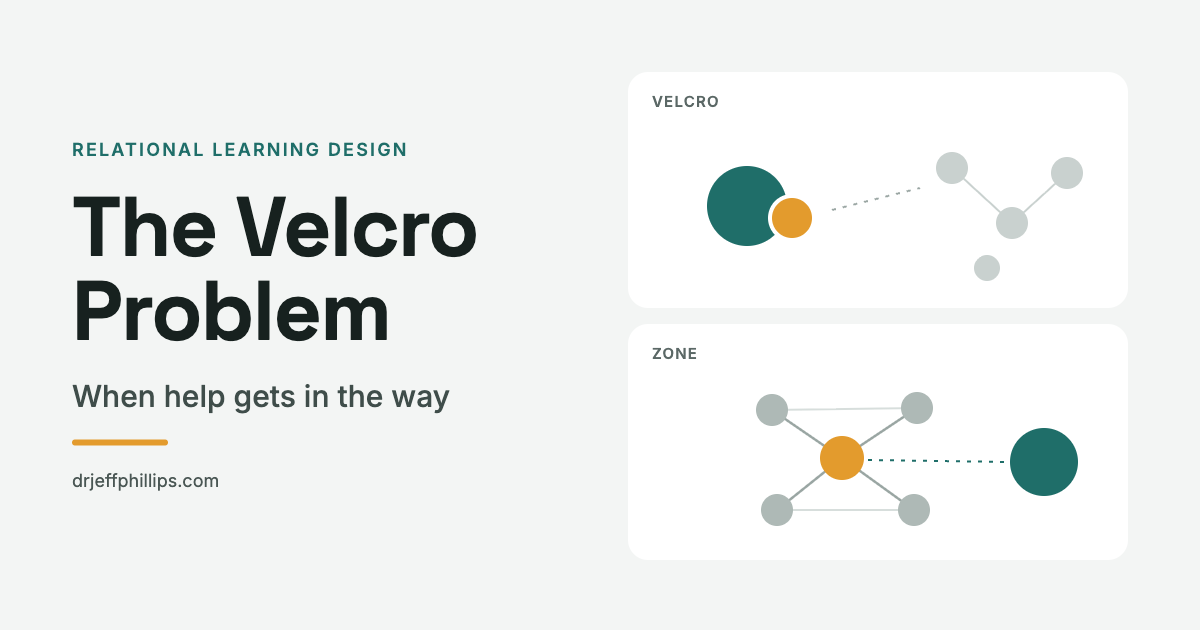
It is often termed “the Velcro problem”, it is a pattern we see where students who have an educational assistant begin a routine of growing more and more dependent on the adult(s) working with them. The support these students receive feels kind, additive, and inclusive - but it isn’t the shape an intervention should take. Michael Giangreco and colleagues (1997) have written about the helping/hovering dynamic that instructional assistants find themselves in, and they found that teachers in classrooms with aides pulled back their own support of the learner who the assistant worked with, classmates pulled back as well, and the student receiving the additional support often grew dependent on their prompting.
Why does it keep happening? Vivash and Morgan (2019) found that the additional adult becomes the differentiation rather than the teacher designing better supports. According to the Deployment and Impact of Support Staff (DISS) study, which followed thousands of UK students, the more support a student received the less progress they made. The fault wasn’t necessarily with the aides but rather with their use and the systems in place at the school. This is where Universal Design for Learning (UDL) and the Relational Learning Design framework can help teachers to plan for the learning for all students.
Providing support within an RLD system means leaning on relationships while giving students room to own their learning. That matters. Reeve and Tseng (2011) found that students who actively shape their learning, by asking questions, voicing preferences and steering the lesson, achieve more. Later research frames this agentic engagement as a student-driven pathway to greater achievement. Feedback matters too. In Ruth Butler’s (1987) study, written comments supported task-focused attitudes, while grades and praise pushed students toward ego-focused ones. Interest and performance were highest after students received comments. An adult hovering at a child’s elbow can’t build that. Students need room to try, stumble and hear what to do next.
So what does this look like on a Monday morning? One answer is zone teaching. Instead of assigning an adult to one child, each adult takes a zone. That might be a part of the room, a small group, or a station. The aide still works with the student who needs support. But they also help the kids around them. The student is no longer “the kid with the helper.” They’re just part of the group.
This changes a few things. The teacher stays in charge of every learner’s plan, including the student with an aide. Peers stay close because there’s no adult wall in the way. And the aide can step back on purpose. They give a prompt, then move on. They check in later instead of hovering now. That space is where agency grows.
Zone teaching fits the RLD lens well. Adults still see each student. They connect kids to each other, not just to an adult. They include by design. And they sustain learning by fading help as skills grow. The goal isn’t less support. It’s support that builds independence instead of dependence.
So here’s my question for school leaders. Who in your building is Velcroed? What would happen if the adult took three steps back? Start there. Watch who steps in.
